
How to change your KiwiSaver provider (and what to check first)

Angela is a financial adviser specialising in KiwiSaver and retirement income.
Last Updated: September 2026
Switching your KiwiSaver provider can take just 10 minutes.
You don't need permission. You don't need to write a breakup letter to your current KiwiSaver provider. You don't even need to tell them you're leaving.
But even though switching is easy, choosing a new KiwiSaver provider can be hard.
The 10-minute switch is the easy part. But the part that actually affects your retirement is what you switch to. That's where most people get it wrong.
So in this article, you’ll learn how to change your KiwiSaver provider, and what to check first.
Can you change your KiwiSaver provider?
Yes. You can change your KiwiSaver provider at any time, for any reason.
You don't need your current provider's sign-off. You don't need to tell your employer. And you don't need to notify Inland Revenue. That all happens automatically behind the scenes.
The only rule is that you can only be with one KiwiSaver provider at a time. When you join a new one, you leave the old one.
However, that doesn’t mean you can only invest in one KiwiSaver fund at a time. If you use KiwiWRAP, for instance, you can split your KiwiSaver investments across multiple funds and assets.
To do that, you need a KiwiSaver balance of at least $50,000 and need to work with a financial adviser.
Got more than $50,000 in your KiwiSaver?
You have an option most people don't know exists. Through a financial adviser, you can access KiwiWRAP — a KiwiSaver scheme that lets you invest across multiple fund managers instead of being locked into one provider's menu.
If you're looking for a financial adviser to access KiwiWRAP, book a meeting to discuss your KiwiSaver options.
How do you actually switch KiwiSaver providers?
It’s easy to switch your KiwiSaver provider. All you need to do is apply directly with your new provider. The steps are:
Choose your new provider and fund. (More on how to do this properly below.)
Apply on their website, usingyour name, IRD number, date of birth, and prescribed investor rate.
Verify your identity. Because you're a new customer, the new provider has to identify you under anti-money-laundering rules. It's a one-time thing when you join. Usually that's a photo of your driver licence or passport done online. Though, some providers ask for certified ID. That’s a copy signed off by a JP or lawyer. Some providers might also ask for more identification documents such as your proof of address.
The providers and Inland Revenue do the rest. Your new provider requests the transfer. IRD gets notified automatically. Your old provider sells your units and sends the money across.
You never touch the money. It moves provider-to-provider.
And if forms aren't your thing: work with a financial adviser and they handle the entire switch for you.
How long does it take to switch KiwiSaver providers?
It often takes around ten working days to switch KiwiSaver providers. That’s from your application to your balance appearing with the new provider. In other words, it typically take 2 weeks all up.
One thing to know: there's a short window where your money is between funds. That’s the time from when you’ve sold your units in one fund, but the money isn’t invested in the new one yet. It's usually only a few days, but if markets jump in that window, you miss it.
If they fall, you miss that too. It cuts both ways.
Does it cost money to switch KiwiSaver providers?
Most KiwiSaver providers such as BNZ, Westpac, Generate and Simplicity don’t charge exit fees. However a small number of providers may charge one. For example Booster charges a flat $30 fee when you move to a different provider.
Some funds may also have buy/sell spread costs. That’s a tiny percentage built into the unit price when you enter or exit a fund. It's not a fee that shows up on a statement, but it's worth knowing it can exist.
What should you check before you switch KiwiSaver providers?
Most people switch KiwiSaver providers looking for cheaper fees.
And fees matter. Over 30 years, a difference of 0.5% in fees can compound into tens of thousands of dollars.
But cheapest isn't the same as best. Here's what to actually compare:
1. Fees – in context.
An active fund manager (one that picks investments, trying to beat the market – think Milford or Fisher Funds) tends to charge more.
For a growth fund, that's typically around 1% a year, sometimes more.
A passive fund (one that simply follows the market – think Simplicity or Kernel) charges less.
Neither is “right.”
The question is: what are you paying for?
If you're paying active-manager fees, you should be getting active management you believe in.
If you just want to follow the market, don't pay a premium for stock-picking you never asked for.
2. Asset allocation.
This is what your fund actually holds. Funds hold a mix of growth or income assets.
Growth assets tend to increase in value faster. But they go up and down in value more.
Income assets to deliver a lower return. But that return is more stable.
Aggressive and growth funds hold more growth assets, and fewer income assets.
Whereas more conservative funds hold a lower proportion of growth assets, and relatively more income assets.
Over time those differences in returns can add up.
The chart below simulates investing $1,000 a month since 2007 across three risk levels. Same money in, very different outcomes:
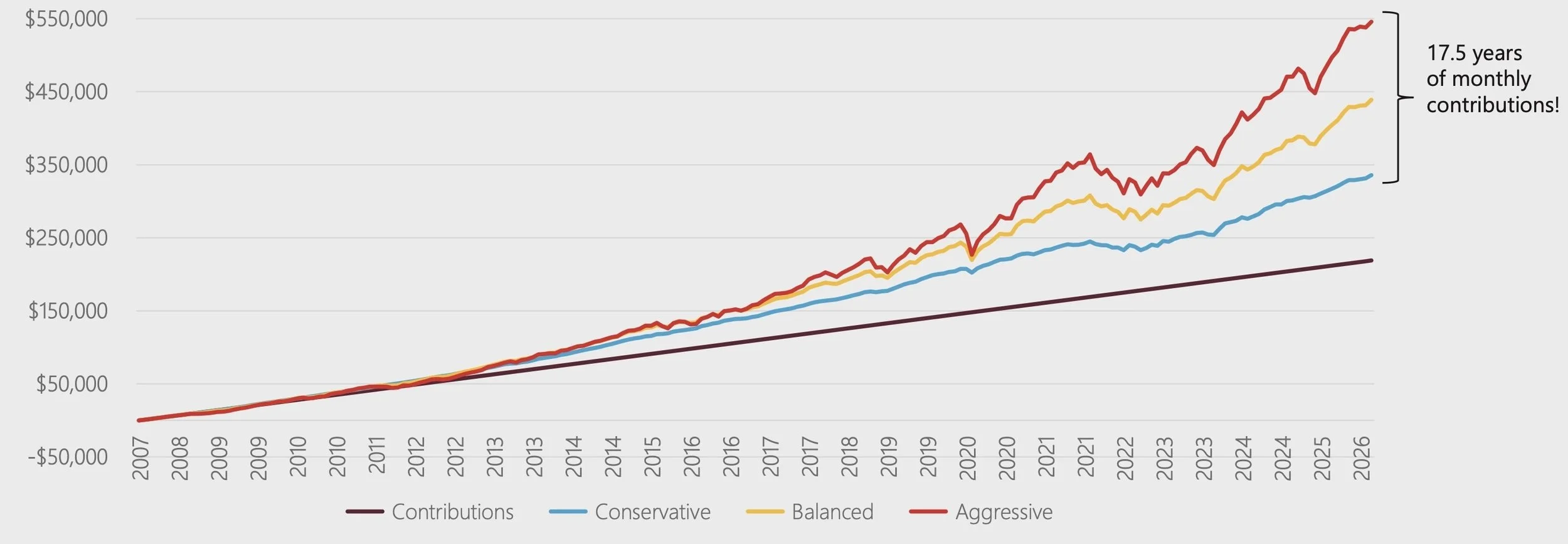
Source: Consilium calculations using Morningstar returns. Simulated balances assume $1,000 contributed per month, after fund costs, before advice fees and tax.
After 17.5 years of identical contributions, the conservative investor has around $330,000. The aggressive investor has around $550,000. That's a difference of over $200,000 from fund type alone.
Notice the dips too. The aggressive line fell hard in 2020. That's the deal: higher long-run returns in exchange for a rougher ride. Which risk level suits you depends on how long until you need the money, not on which line finished highest.
And this is why the numbers get serious at a $50,000 balance. A one percent difference in returns on $5,000 is $50. It’s barely noticeable.
On $50,000 it's $500 a year, compounding every year after. The bigger your balance, the more being in the right fund is worth and the more a wrong default setting quietly costs.
3. What the fund is trying to achieve.
Every fund has an investment objective and a benchmark (what it's trying to beat or follow). If you don't know your fund's objective, you don't really know your fund.
Angela's test
If someone asks about your KiwiSaver, you should be able to answer three questions:
- What does my fund hold?
- What am I paying?
- And what is it trying to achieve?
If you can't answer all three, do that homework before you switch. Not after.
The most common switching mistake
The most common KiwiSaver mistake I see, as a financial adviser, is when investors switch purely based on price.
People see a cheaper fee and jump without checking whether the new fund's asset allocation matches their timeline. They save 0.3% in fees, but could end up in a fund that's wrong for them. That can cost more than the fee ever did.
Should you just switch your KiwiSaver yourself, or talk to a financial adviser?
If you already know:
what fund type suits your age and timeline,
and you've done the three-question test above,
You can easily switch yourself this afternoon. It's genuinely a 10-minute job.
But if you're switching because of a billboard, a mate's tip, or a fee comparison you half-read ... that's when you should talk to a financial adviser first. Because switching funds is basically free. But switching to a fund that doesn’t suit you still costs.

Angela McKnight
Angela is a financial adviser specialising in KiwiSaver and retirement income.
Angela spent ten years in finance and banking working with high-net-worth clients before founding Frank Wealth. She helps Kiwis grow their wealth and turn it into income that lasts through retirement. Angela is based in Auckland.
Disclaimer: This article provides general information and does not constitute financial advice. You should speak to a financial adviser about your specific situation. Frank Wealth adviser costs are outlined here.
