
Is Bitcoin a Scam?

Angela is a financial adviser specialising in KiwiSaver and retirement income.
Last updated: March 2026
We hear this question constantly. Sometimes from curious clients wondering whether they should buy some, more often from distressed ones wondering why they did. The answer, technically, is no: Bitcoin is not a scam in the legal sense. It's a real asset, with real technology behind it, traded on real exchanges.
But here's the thing. For the many ordinary investors who bought it based on the hype during the peaks of 2017 or 2021, encouraged by headlines, social media, and in some cases paid celebrity endorsements, the practical experience has been indistinguishable from one. Let's look at the numbers honestly.
“Bitcoin has made a small number of early adopters extraordinarily wealthy. It has also destroyed the savings of millions who arrived late to the party and were never warned how bad the hangover could be.”
The Crash Record Is Unlike Anything in Mainstream Finance
Bitcoin's volatility is not a growing pain or a temporary quirk. It is a fundamental, persistent feature of the asset and the scale of its crashes has no parallel in legitimate investment markets. In its sixteen-year history, Bitcoin has suffered four separate crashes of 77% or more. For context, that’s the worst market crash most investors will face in their lifetime. The 2008 Global Financial Crisis saw the S&P 500 fall approximately 57% over two years. Bitcoin has been worse than that, four times over!
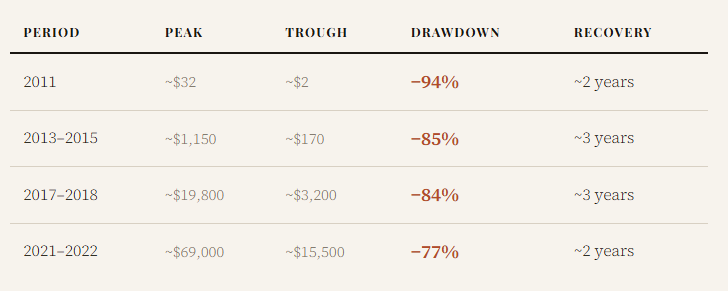
Let's make the 2021–2022 crash concrete. If you invested $50,000 at Bitcoin's peak in November 2021 (a perfectly rational moment to buy, given the wall-to-wall positive media coverage) your holding was worth approximately $11,250 twelve months later. You would have needed Bitcoin to quadruple just to return to break-even. Many investors didn't wait. They sold, crystallised the losses, and the damage was permanent.
How Does It Stack Up Against Real Investments?
Bitcoin advocates LOOVEEE to quote the long-run numbers. And yes, if you bought in 2013 and held through every crash without flinching an eye, the returns have been extraordinary. But this framing obscures a crucial reality. The vast majority of retail investors don't buy early and hold serenely through 80% drawdowns. They buy during peak euphoria and sell during panic. The theoretical long-run return and the actual return experienced by most Bitcoin investors are very different numbers.
Here's a side-by-side of Bitcoin versus the S&P500 in the years that actually hurt.
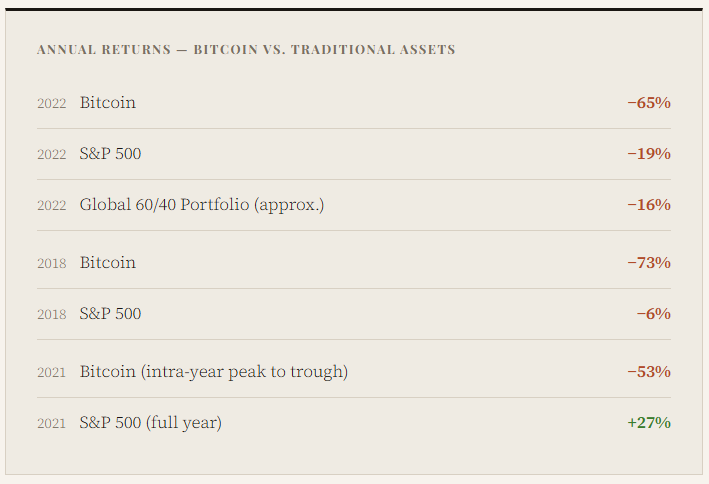
2022 is particularly instructive. It was a genuinely difficult year for nearly every asset class. Inflation, rising rates, geopolitical instability etc. The S&P 500 fell 19%, which was painful. A balanced portfolio lost around 16%. Bitcoin lost 65%. It offered no protection, no diversification benefit, and no safe-haven characteristics whatsoever. It simply amplified every problem the market was already experiencing.
The "Just Hold" Advice Ignores How Humans Actually Work
The standard Bitcoin rebuttal is: ‘hold long enough and you'll be fine’. When an investment falls 50% in three months, people sell. This is not weakness or irrationality, it's human nature. The psychological pain of losses is felt approximately twice as intensely as the pleasure of equivalent gains. Watching $100,000 become $35,000 does not feel like a buying opportunity. It feels like a catastrophe. For investors who had money in Bitcoin that they genuinely needed for retirement, for a house deposit, for their children's education, it was a catastrophe.
The investors who built real wealth from Bitcoin largely bought before 2017, when prices were measured in hundreds of dollars and barely anyone was paying attention. The investors who have been hurt are overwhelmingly those who bought during the media frenzies of 2017 and 2021 driven by aggressive coverage, influencer promotions, and in numerous documented cases, celebrities who were being paid to hype specific tokens without disclosing it.
“An asset that requires you to endure years of 80% losses to eventually see a return is not a practical investment for most people. It’s an endurance test and most people fail it.”
The Ecosystem Around Bitcoin Is Genuinely Treacherous
Even if you accept Bitcoin itself as a legitimate (if highly speculative) asset, the industry surrounding it has produced an almost unbroken stream of fraud, collapse, and investor harm. FTX, once the world's second-largest crypto exchange, endorsed by celebrities, valued at $32 billion, and backed by respected venture capital firms, collapsed in November 2022 after it emerged that founder Sam Bankman-Fried had been using customer funds to prop up his personal trading operation. He was convicted of fraud and sentenced to 25 years in prison. Customers lost billions and many have never recovered their funds.
FTX was not an outlier. Celsius Network froze all customer withdrawals in June 2022 before filing for bankruptcy, leaving retail depositors locked out of their own savings.
Terra/LUNA, a cryptocurrency with a $40 billion market capitalisation, collapsed to near zero within 72 hours in May 2022, wiping out investors who had been told it was a "stablecoin."
Bitconnect. OneCoin. Dozens of smaller exchanges and projects that turned out to be outright theft. The problem isn't just that these things happened. It's that they keep happening, and retail investors keep losing.
The Risk Doesn't Match the Reward for Most People
Our position is straightforward. For the overwhelming majority of our clients, Bitcoin has no meaningful place in a well-constructed portfolio. Not because it's illegal, not because the technology is worthless, but because the risk profile is fundamentally incompatible with what most people are trying to do: build and preserve wealth over time, reliably, without catastrophic drawdowns that derail their financial plans.
If you have genuine discretionary capital, as in, money you genuinely could afford to lose entirely without it affecting your life, and want a small speculative position, that's a conversation we're open to. What we're not open to is encouraging anyone to hold Bitcoin with money that matters, at a size that matters, because the internet told them it's "digital gold." The numbers don't support that narrative. The crash history doesn't support it. And the wreckage of the last two bull-and-bust cycles is littered with people who found that out too late.

Angela McKnight
Angela is a financial adviser specialising in KiwiSaver and retirement income.
Angela spent ten years in finance and banking working with high-net-worth clients before founding Frank Wealth. She helps Kiwis grow their wealth and turn it into income that lasts through retirement. Angela is based in Auckland.
Important Disclaimer: This article represents the opinion of our team and is provided for general informational purposes only. It does not constitute financial, investment, or legal advice. All investments carry risk, including the possible loss of principal. Historical performance data cited is approximate, sourced from publicly available market records, and is not indicative of future results. Readers should conduct their own due diligence and consult a qualified financial adviser before making any investment decisions.
